
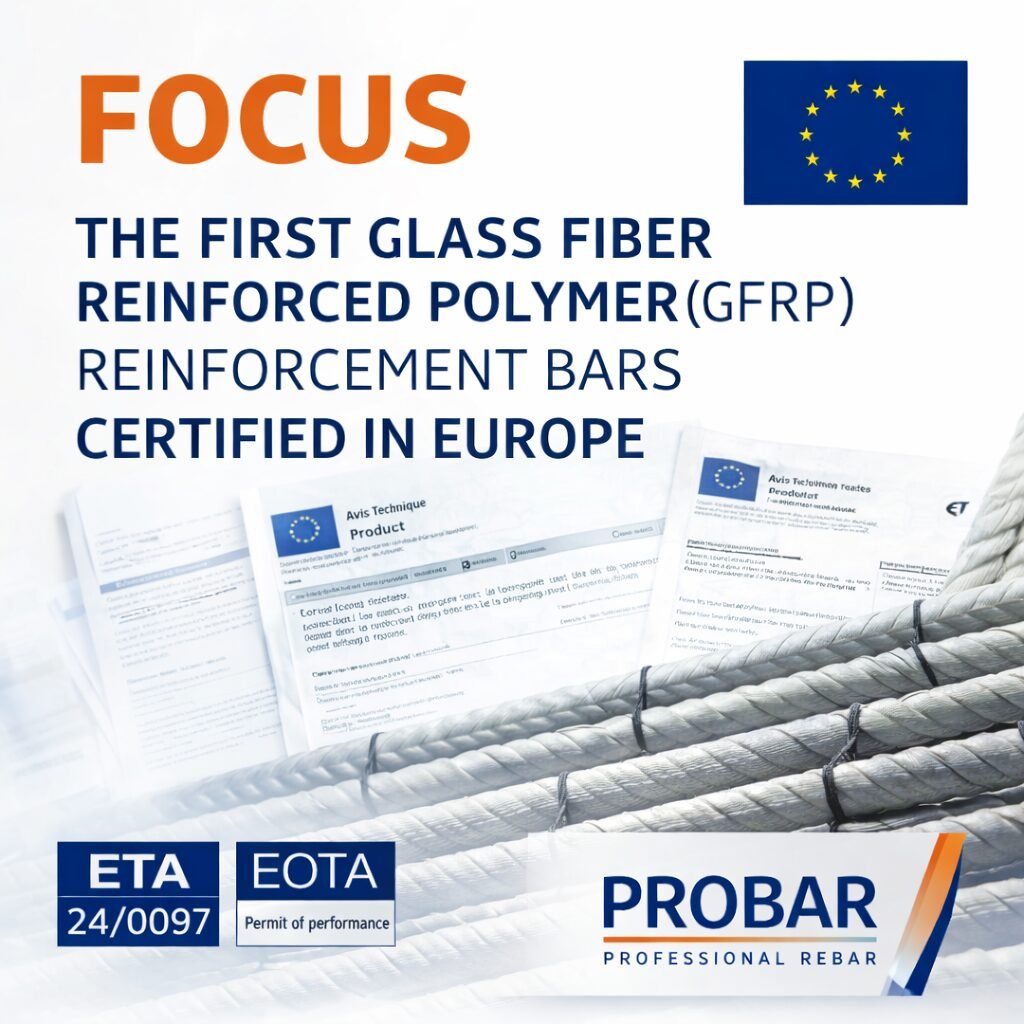
After reviewing the history, advantages, and applications of GFRP reinforcements, let’s take a closer look at one of the latest innovations on the market. This product stands out as the first GFRP reinforcement bar to obtain a European Technical Assessment (ETA), a mark of quality and compliance with modern construction requirements.
What is this GFRP reinforcement bar?
This GFRP reinforcement bar is made of continuous E-CR glass fibers embedded in a high-performance polymer matrix (structural vinylester resin), forming a pultruded bar with nominal diameters equivalent to standard steel bars. A sand-coated surface ensures concrete bonding comparable to high-adhesion steel bars. The bars are available in common diameters (from ~4 mm to 32 mm) to meet the needs of building and civil engineering applications.[1]
Key advantages:
High tensile strength: On average, the GFRP bar has double the tensile strength of standard steel (Fe500). For example, characteristic strength can exceed 1000 MPa compared to ~500 MPa for steel
[2]. This means that, for the same diameter, the bar can withstand more stress before failure. In some cases, this allows reducing the number of bars (reinforcement optimization) while still meeting strength requirements.
Exceptional lightness: The GFRP bar is about 4 times lighter than steel (density ~2,000 kg/m³ vs. 7,850 kg/m³)
[2]. For construction crews, this is a major advantage: easier handling, no crane needed for most operations, reduced labor strain, and lower accident risks during installation. Transport is also simplified: 1,000 kg of GFRP bars corresponds to four times more linear meters than 1,000 kg of steel.
Absolute corrosion resistance: The GFRP bar is inert to corrosion. Water, chlorides, or acidic environments do not significantly affect it. This makes it ideal for aggressive environments. Concrete cover can be reduced since corrosion protection is unnecessary, saving weight and material. No anti-corrosion maintenance is needed, ensuring long-term durability of the structure.
Electrical and magnetic neutrality: Being non-metallic, the GFRP bar is electrically insulating and non-magnetic. This makes it suitable for hospitals (MRI), structures exposed to currents, or sensitive laboratories
[2]. For project owners, this allows meeting precise technical requirements without interference from metallic reinforcement.
Eurocode compatibility and CE certification: The GFRP bar has been tested and approved under the European assessment framework EAD 260023-00-0301 and obtained a European Technical Assessment (ETA 24/0295) in 2024, confirming its performance and structural suitability
[1]. This ensures it meets all resistance, stiffness, bonding, and durability requirements. The CE marking guarantees regulatory compliance in Europe, allowing specification without additional experimental procedures. This facilitates approval by control authorities on construction sites.
High-quality manufacturing and monitoring: The bars are produced using a controlled pultrusion process, ensuring product uniformity. Each production lot undergoes tests (tensile strength, modulus, dimensions) according to ASTM and ISO standards. The bars include alkali-resistant E-CR glass fibers, high-performance vinylester resin, UV additives, and optionally flame retardants for enhanced durability[3].
In summary, this GFRP bar offers a high-performance reinforcement solution, combining the known benefits of GFRP with official certification and compliance with current design codes. Pilot projects and first commercial applications have demonstrated its effectiveness in corrosion protection, tunnel reinforcement, and technical structures.
Comparative table (GFRP bar vs. steel)
| Criteria | GFRP Bar | Standard Steel Bar |
| Tensile strength | ~1000 – 1200 MPa (depending on Ø) [2] | ~500 MPa (Fe500 standard) |
| Elastic modulus | 60 – 70 GPa (~25% of steel) [2] | ~210 GPa |
| Density | ~1900 kg/m³ [2] | ~7850 kg/m³ |
| Corrosion | None [2] | High in aggressive environments |
| Electrical conductivity | None (insulator) [2] | Excellent (metal conductor) |
| Magnetism | None, MRI-compatible [2] | Ferromagnetic |
| Max temperature | ~60–70°C without degradation | ≥500°C (bare steel) |
| Ductility | Brittle (elongation <2%) | Ductile (>5% elongation) |
| Formability | No welding or cold bending | Weldable, cold-bendable |
| Expected lifespan | 75–100 years in marine environment [2] | 20–30 years (with maintenance) [2] |
This table highlights that the GFRP bar outperforms steel in durability-critical aspects, while requiring design adjustments due to its brittle behavior and lower stiffness.
Installation and feedback
The GFRP bar is used similarly to conventional steel reinforcement, with specific best practices:
- Bars must be pre-formed; no on-site bending. Prefabricated stirrups or straight sections can be delivered.
- Tying is done with polymer wire or plastic clips to avoid metal interference.
- Concrete cover can be slightly reduced, but minimum Eurocode cover is recommended for fire safety
[3]. - Cutting is done with a grinder or diamond saw; wear a mask due to abrasive glass dust.
- Due to light weight, bars may need securing on windy sites. Plastic spacers help maintain correct positioning.
- During concrete pouring, no extra precautions are needed; the bars do not float or react with cement.
Construction teams reported high satisfaction: easier handling, reduced injuries, and faster installation. For example, in industrial flooring, crews installed twice as much reinforcement per day compared to traditional steel without lifting equipment.
Conclusion
With this GFRP bar, composite reinforcements enter a new era of official recognition and seamless integration into standard projects. Designers can now specify it as they would steel, knowing it meets standards (ETA) and behaves predictably. Steel remains relevant in many cases, but this GFRP solution offers a credible alternative where steel has limitations. Each project can now compare GFRP and steel to select the optimal solution, supporting smarter, more durable, and innovative construction for the 21st century.